AI test generation that doesn't break the build — where generated tests help and where they hurt
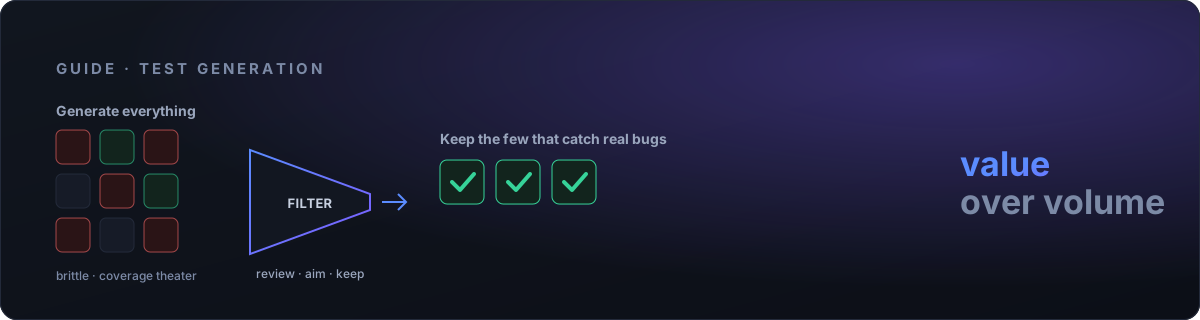
AI can write your tests. That's not the same as helping.
Point an AI at your repo and tell it to "generate tests for everything," and it will. You'll get hundreds of new test files by lunch. Coverage jumps. The dashboard turns green.
Then the trouble starts. A refactor that changes nothing about behavior turns half the suite red. A teammate opens a failing test, reads it, and can't tell whether it caught a real bug or just noticed that a private method got renamed. CI slows down. People start adding .skip. Within a month the generated tests are noise that everyone routes around.
This is the real fear behind AI test generation, and it's a reasonable one. The failure mode isn't "the AI can't write tests." It's that volume-first generation produces brittle, low-value tests that break the build and erode trust in the whole suite.
Used deliberately, though, generated tests are one of the highest-leverage things AI does in a QA pipeline. The difference is entirely in where you point it.
Why "generate tests for everything" fails
Three things go wrong, and they compound.
Coverage theater. A test that executes a line without asserting anything meaningful counts toward coverage but catches nothing. Chase a percentage and you get a suite full of these — green numbers, zero protection. You've made the metric lie.
Assertions pinned to implementation. AI generators infer expected values from current behavior. Left unsupervised, they'll assert on internal structure, call order, private helpers, and exact string formats that have nothing to do with what the code is supposed to do. Every one of those is a tripwire that fires on the next refactor.
Tests that pass meaninglessly or break constantly. You end up with the worst of both: tests too loose to catch regressions and too tight to survive normal change. Both flavors train your team to ignore red.
None of this means the tool is bad. It means "everything" is the wrong target.
Where generated tests genuinely help
There are places where AI generation is not just safe but better than what a human would bother to do by hand.
- Characterization tests for untested legacy paths. You have a gnarly module nobody wants to touch and no tests around it. AI can pin down what it currently does so you can refactor with a safety net. You're not asserting correctness here — you're freezing existing behavior, and that's exactly the job.
- Filling coverage gaps your reviewer keeps flagging. When AI code review repeatedly points at the same untested branch, that's a precise, human-vetted target. Generate a test for that branch, not the whole file.
- Boilerplate and edge-case enumeration for pure functions. For a function with clear inputs and outputs and no side effects, machines are excellent at grinding through null, empty, boundary, and overflow cases you'd skip when tired.
- Regression tests pinned to a real bug. A bug just shipped and got fixed. Generating a focused test that reproduces the original failure and now passes is high-value and durable — it's tied to a fact about your system, not to today's implementation.
The pattern across all four: a narrow, specific target that a human already cares about. That's where generation earns its keep.
Where it hurts
- End-to-end and integration tests. These need real environment knowledge, orchestration, and judgment about what "working" means across services. Generated E2E tests tend to be flaky and expensive to maintain — high blast radius, low signal.
- Anything requiring domain judgment. Whether an invoice calculation is correct — not just consistent — is a business question. AI can encode the current answer, but it can't tell you the current answer is right.
- Chasing a coverage percentage. The moment the goal becomes a number instead of protection against real defects, you're back in coverage theater. Volume is not the outcome you want.
How to adopt it without the mess
Sequence matters more than tooling here.
- Put it after trusted review, not before. In a layered AI QA strategy, test generation is layer two — you adopt it after AI code review is earning trust. Review tells you where coverage is thin; generation fills those specific gaps. Reverse the order and you're generating tests blind.
- Review every generated test like any other PR. A generated test is a change to your codebase and gets the same scrutiny. If a human can't read it and say what regression it protects against, it doesn't merge. No batch-approving a hundred files.
- Tune for value, not volume. Configure generation toward the narrow, high-signal targets above. Fewer, sharper tests beat a wall of green that nobody trusts — the same precision-over-recall logic that keeps AI code review from getting muted. Noise erodes trust in test suites exactly the way it does in review comments.
- Delete tests that don't earn their keep. A generated test that breaks on every refactor and has never caught a real bug is a liability. Removing it is a win, not a regression. Measure the suite by defects caught and refactors survived, not by line count.
Several tools focus specifically on test generation — Diffblue, Qodo, and TestSprite among them — and they differ in language support, how they handle mocking, and how tightly they pin assertions. The right choice depends on your stack. But the tool is the easy part. The hard part is the discipline about where you aim it and what you let through review.
The principle underneath
Generated tests follow the same rules as everything else we run.
Assistive: the AI drafts, a human approves. No test enters the suite without someone confirming it protects against something real.
Precision over recall: a smaller set of tests that catch real regressions beats broad coverage that floods CI with brittle failures. In our blind test on excalidraw, the goal was catching the two reverted regressions while leaving the one correct change alone — signal, not volume. Test generation is judged the same way.
Measure quality, not activity. Test count is activity. Defects caught and refactors survived is quality. If your generated tests aren't moving the second number, generating more of them won't help.
AI test generation works. It works when it's the second layer of a trusted pipeline, aimed at narrow targets, gated by a human, and measured by what it actually catches.
Want generated tests that survive your next refactor?
We integrate and run AI test generation inside your environment, sequenced after review and tuned for value over volume — assistive, human-approved, measured by defects caught. Get in touch to talk through where it fits in your stack.