The best AI QA strategy for software teams — a practical playbook
Most teams confuse buying an AI QA tool with having an AI QA strategy. They install CodeRabbit or Qodo, watch it flood the first ten pull requests with comments, and quietly mute it a month later. The tool wasn't the problem. The absence of a strategy was.
A real AI QA strategy answers four questions: where AI helps most, in what order to adopt it, where humans must stay in control, and how you'll know it's working. Here's the playbook we use with small and mid-size teams.
Start from the bottleneck, not the tool
The biggest mistake is leading with capability — "AI can write tests, so let's generate tests." Lead with your actual constraint instead. On most 10–50 dev teams the bottleneck is code review: reviewers are fatigued, PRs sit in the queue, and regressions slip through because the third reviewer of the day is skimming.
So the highest-ROI place to start is almost always AI-assisted code review, not test generation. It attacks the real bottleneck, it has a low blast radius (it comments, it doesn't ship), and the value is visible on day one. Map your pipeline, find where work actually piles up, and point AI there first.
Adopt in layers, not all at once
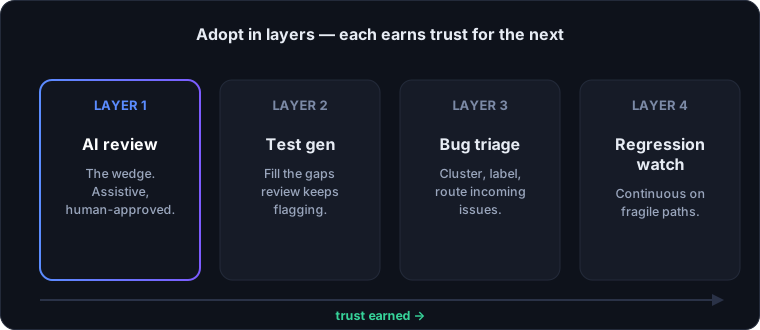
A QA strategy is a sequence, not a switch. Adopt in this order, and don't move to the next layer until the previous one is trusted:
- AI code review (assistive). The agent reviews every PR, surfaces high-value findings with a file:line and a concrete fix, and defers the merge decision to a human. This is the wedge — and choosing the right reviewer starts with how to pick that tool.
- Test generation for the gaps. Once review is trusted, use AI to generate tests for the untested paths it keeps flagging — raising coverage where it actually matters, not chasing a vanity percentage.
- Bug triage and routing. As volume grows, let AI cluster, label, and route incoming issues so humans spend judgment where it counts.
- Regression watch. Continuous checks on the paths most likely to break, tuned to your codebase's real history of incidents.
Each layer earns trust for the next. Teams that try to switch on everything at once get noise everywhere and trust nowhere.
Assistive, never autonomous — at least at first
The fastest way to lose a team's trust (and create real liability) is to let AI auto-merge or modify code on day one. The strategy that sticks is assistive: AI recommends, a human approves. Keep these guardrails non-negotiable:
- Read-and-comment only to start — no auto-merge, no auto-commit.
- A human-approval gate on every action that touches the codebase.
- Metered, capped AI cost so a runaway loop or a giant PR never surprises you.
You can widen autonomy later, on the paths where the AI has earned it. But trust is earned narrow and lost wide.
Precision beats recall
A QA strategy lives or dies on signal-to-noise. A reviewer that flags thirty nitpicks per PR looks thorough in a demo and gets ignored in production. One that surfaces the two findings that actually matter gets read every time.
So tune relentlessly for precision over recall. It is far better to catch the one real regression and stay silent on clean code than to catch everything and train your team to mute the channel. The goal isn't maximum coverage of comments — it's maximum trust per comment.
Measure quality, not activity
If you can't see what the AI is doing, you can't tune it — and an untuned tool's noise only grows. Instrument the strategy from day one:
- Findings acted-on vs. ignored — the single best proxy for whether the AI is trusted.
- False-positive trend — is precision improving as you tune, or drifting?
- Review time and queue depth — is the bottleneck actually shrinking?
- Regressions caught pre-merge — the outcome that justifies the whole thing.
Activity metrics (comments posted, PRs scanned) flatter the tool. Quality metrics tell you whether the strategy works. Track the second kind.
Integration is the strategy
Here's the part most teams underestimate: the model isn't the moat, and neither is the tool. The strategy is the integration — wiring the right tools into your real repo, your real CI, and your real review process, with the guardrails that make them safe and the observability that makes them tunable. That boring engineering is what separates an AI QA strategy that compounds from one that gets muted — and on a team without a platform group, that integration is exactly what we do.
We proved the assistive-first, precision-tuned approach works on a real codebase: running blind on the open-source project excalidraw, our reviewer caught two regressions the maintainers had merged and later reverted — and stayed silent on a change that was actually correct (read the full case study). That's the strategy in miniature: catch what matters, stay quiet on what doesn't, and always leave the decision to a human.