Why teams mute their AI code review tool (and how to fix the false-positive problem)
You bought an AI code review tool. The demo was impressive. A month later, half your team has muted its notifications. Sound familiar?
This is the single most common failure mode in AI-assisted QA, and it has nothing to do with the model being "not smart enough." It's about signal-to-noise.
The two ways AI review fails
An AI reviewer is only useful if it does both of these jobs well:
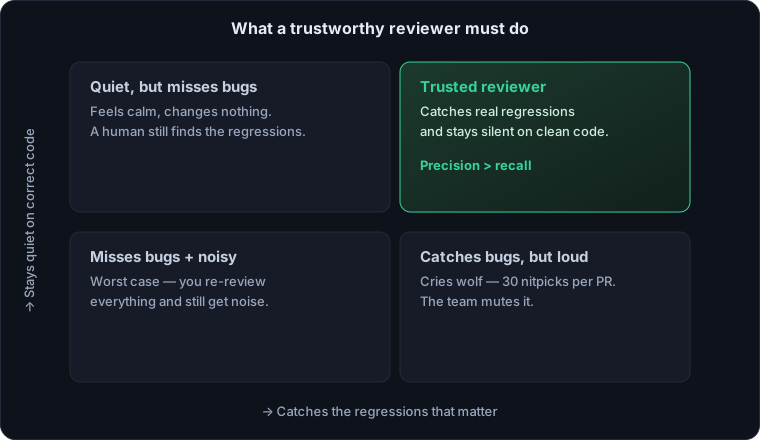
- Catches the regressions that matter. If it misses real bugs, a human has to re-review every pull request anyway — so you're paying for a tool that changed nothing.
- Stays quiet on correct code. If it flags every PR with ten low-value nitpicks, your team learns to scroll past it. And the one real bug scrolls past with the noise.
Most tools, out of the box, fail the second test. They optimise for recall (flag everything, miss nothing) at the cost of precision. The result feels productive in a demo and exhausting in production.
Why it happens
- Default configurations are loud. Vendors tune for "look how much it found" rather than "look how little it wasted your time" — which is why you should evaluate tools on their real false-positive rate.
- No context about your codebase. A generic reviewer doesn't know your conventions, your intentional trade-offs, or which patterns are deliberate. So it flags them.
- No feedback loop. Nobody is curating which findings are useful and tightening the rules. The noise never goes down.
How to make AI review trustworthy
The fix is not a better model — it's the boring engineering around it:
- Tune for precision first. It is better to surface three findings your team acts on than thirty they ignore. Trust compounds; noise destroys it.
- Feed it context. Conventions, architecture notes, and the patterns that are intentional in your repo.
- Add a human-approval gate. The reviewer recommends; a person decides. This keeps it assistive and keeps liability where it belongs.
- Measure it. Track findings acted-on vs ignored, and false-positive rate. If the team trusts it, those numbers tell you. If they don't, the same numbers tell you why.
The test that matters
A reviewer you can trust should catch real, shipped regressions — and stay silent on changes that are actually fine. On a blind test against a mature open-source project (see the full case study), that's exactly the bar we hold ours to: catch the bugs that real reviewers merged and later reverted, without inventing problems on correct code.
If your AI review tool is getting muted, the tool probably isn't the problem — the integration is. That gap is fixable with a real AI QA strategy.