CodeRabbit vs Qodo — an integrator's honest comparison (2026)
Why most "CodeRabbit vs Qodo" comparisons are useless
Search for this comparison and you get two kinds of pages. The first is marketing — from one vendor, or from an affiliate who earns a cut when you sign up. The second is a feature checklist: two columns of green checkmarks that tell you both tools "support GitHub" and "review pull requests" without telling you which one your team will actually keep on after the novelty wears off.
Neither helps, because the thing that decides this choice is not on a feature grid. It is how the tool behaves on your pull requests, in your stack, with your team's tolerance for noise. A tool that is objectively excellent can still get muted in three weeks because it comments too often, or misses the class of bug your team cares about, or does not fit where your code lives.
I run AI QA tooling for small software teams as an integrator. I do not sell CodeRabbit and I do not sell Qodo. I get paid the same regardless of which one you land on — or if you land on neither. So this is written to help you think about the choice, not to push a winner. The honest answer is that the right pick depends on your constraints, and the only way to know for sure is to run both against your own PRs.
How the two tools differ in approach
Both are real, both are well established, and they overlap a lot. But they come from different starting points, and that shapes where each is strongest.
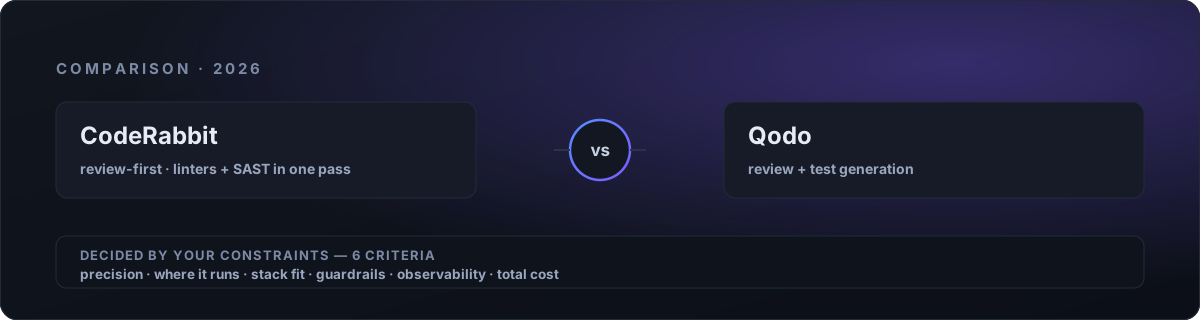
CodeRabbit is a review-first tool. Its core loop is: a PR opens, and it posts conversational, line-by-line comments — flagging likely bugs, logic issues, security and performance concerns, and style problems, often with a suggested fix you can apply in one click. It leans into being a thorough automated reviewer on the PR itself, and it wraps in a broad set of linters and SAST scanners so a single pass covers both AI reasoning and conventional static analysis. It supports GitHub, GitLab, Bitbucket, and Azure DevOps.
Qodo (formerly CodiumAI) grew out of a testing mindset and spans a wider surface. Its PR review product, Qodo Merge, descends from the open-source PR-Agent lineage and does the familiar review work — PR descriptions, structured review comments, improvement suggestions. But Qodo's distinguishing thread is test generation and test-coverage awareness: given a diff, it will surface code paths that are not covered and suggest tests, not just critique the code as written. If review is one axis and "help me get this code tested" is another, Qodo reaches further along the second.
So the shorthand — and it is only shorthand — is: CodeRabbit is a review specialist; Qodo is review plus a test-generation angle. That difference matters less than you would think, though, because for a small team the deciding factors are usually operational, not featural.
The six criteria that actually decide it
This comparison uses the same six-criteria framework I use to evaluate any AI QA tool. It is worth applying deliberately, because these are the drivers that determine whether a tool survives on your team — not the marketing.
- Precision over noise. This is the one that decides everything. A reviewer that flags ten things where two matter trains your developers to scroll past all ten. Both tools can be tuned, but the default signal-to-noise on your codebase differs, and it is the single best predictor of whether the tool gets muted. I have written separately about why teams mute AI code review — almost always it is precision, not capability. Judge each tool on how often its comments are worth acting on, not how many it produces.
- Where it runs. Does the tool need your code to leave your environment, and does that clear your compliance and security posture? Cloud SaaS is the common path for both; deeper self-hosted or on-prem options tend to sit behind enterprise tiers and larger seat counts. If you have data-residency constraints, sort this out first — it can eliminate an option before precision ever matters.
- Stack fit. How well does the tool reason about your languages, frameworks, and conventions? A tool that is sharp on a mainstream TypeScript service may be vaguer on your Go or Elixir code, or on an unusual internal framework. This is highly team-specific and does not show up on any feature list.
- Guardrails and human approval. Assistive tools should advise, not merge. Check how each fits your branch protection and review gates — one-click fixes and auto-suggestions are useful only if a human still approves the change. You want the tool inside your existing approval flow, not routing around it.
- Observability. Can you see whether the tool is actually helping? Are its comments being resolved or dismissed? Without a feedback loop you cannot tune precision, and you cannot justify the cost at renewal. The tool that lets you measure its own hit rate is the one you can keep improving.
- Total cost, including integration. Per-seat pricing is the visible number. The real cost is that plus configuration, tuning, and the ongoing time to keep noise down. A cheaper tool that needs constant babysitting can cost more than a pricier one that is dialed in once and left alone.
When each tends to fit
With those criteria in mind, some honest tendencies — not verdicts:
- CodeRabbit tends to fit teams that want a strong, opinionated automated reviewer on every PR, value the bundled linter and SAST coverage in one pass, and are primarily solving "catch problems at review time."
- Qodo tends to fit teams where testing is the weak link — thin coverage, few tests written under deadline — and who want review and a nudge toward the tests they are missing, or who value its open-source PR-Agent roots.
- Either can be the wrong choice if the defaults are too noisy for your team, if stack fit is poor for your languages, or if where-it-runs does not clear your constraints. None of that is knowable from a demo.
Notice that most of these come down to your situation, not the tools' raw quality. Both are good. The question is which is good for you.
The honest close
There is no universal winner here, and anyone who gives you one is selling something. The right pick depends on your precision tolerance, your stack, where your code is allowed to run, and how the tool sits inside your approval flow. Those are your constraints, and they decide it.
The good news is you do not have to guess. Both tools run on real pull requests, so the correct evaluation is a bake-off on your own PRs — same recent diffs through each, scored on precision, stack fit, and how the comments land with your actual developers. That is exactly the kind of neutral, hands-on evaluation I run. No stake in either tool, just an honest read on which one your team will still be using in six months.
If you want that run for you, get in touch and we will set up a side-by-side on your codebase.