How to evaluate AI QA tools — a practical selection framework
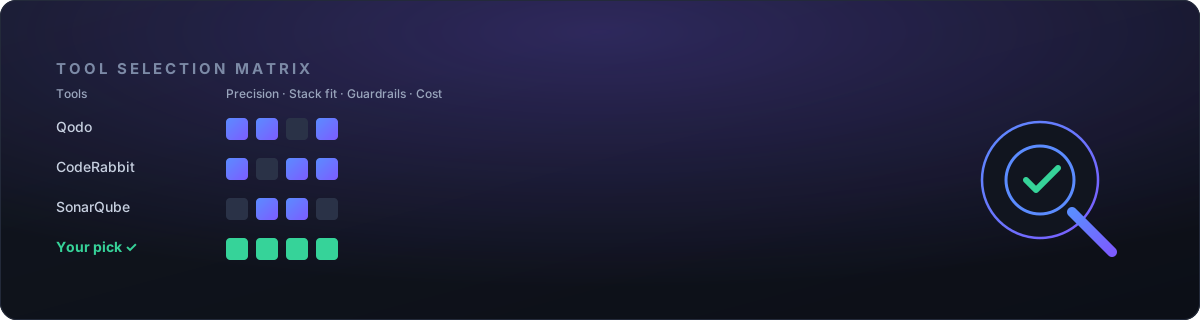
The AI QA tool market is crowded and loud — Qodo, CodeRabbit, SonarQube, TestSprite, Diffblue, and a new entrant every month. Most comparison content is either marketing or a feature checklist. Neither tells you what you actually need to know: will this tool still be in use six months from now, or muted and forgotten?
Here's a vendor-neutral framework for evaluating AI QA tools by the criteria that predict adoption.
1. Precision over recall
Ask every vendor: what is your false-positive rate on a real codebase? A tool that flags everything looks impressive in a demo and gets ignored in production. The tools that stick are the ones that surface a few high-value findings, not thirty nitpicks. Weight this criterion the heaviest — it's the number-one reason tools get muted.
2. Where it runs
- Does it run inside your CI/GitHub, or does it pull your code to a separate cloud?
- For many teams, "runs in our own environment" is a hard requirement for trust and compliance (here's why running in your own environment matters). Know your constraint before you shortlist.
3. Fit with your stack
A tool that's excellent for Java may be mediocre for your TypeScript monorepo. Test candidates on your actual code and your actual languages, not on the vendor's curated examples. Stack fit is non-transferable.
4. The guardrails it gives you
- Can you keep it read-and-comment only (no auto-merge)?
- Does it support a human-approval gate?
- Can you meter and cap the AI cost?
If a tool can't be made assistive and controllable, it's a liability risk, not a productivity tool.
5. Observability
Can you see what it's doing — findings acted-on vs ignored, false-positive trend, time saved? Without this you can't tune it, and an untuned tool's noise only grows.
6. Total cost, honestly
Tool license is rarely the expensive part. The real costs are integration effort and your engineers' attention. A cheaper tool that takes three weeks to wire in and floods your team is more expensive than a pricier one that works in three days.
Turn it into a matrix
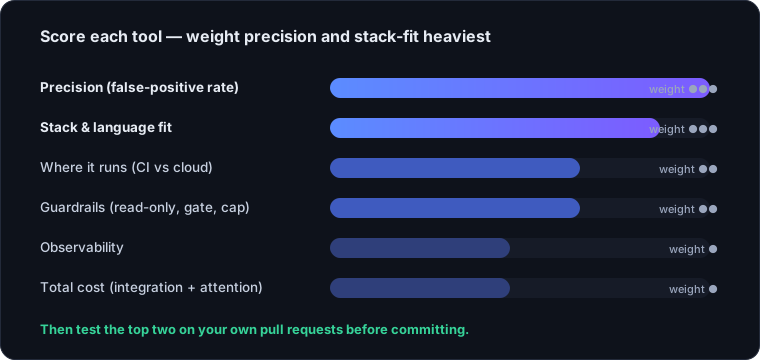
Score each candidate 1–5 on the six criteria above, weight precision and stack-fit highest, and test the top two on your own pull requests before committing. For a worked example applying this framework to two popular tools, see CodeRabbit vs Qodo. The winner is rarely the one with the longest feature list — it's the one your team still trusts a month in.
That last test — running candidates on your real code — is the step most teams skip and the one that actually predicts success.